This article was accurate at the time of publication in July 2026 and is reviewed regularly to reflect changes to the Workday platform and commercial model.
For most of the time you have been a Workday customer, what you paid was settled at contract. You agreed to a set of products, paid an annual fee, and had largely uncapped use of the underlying platform. Once the contract was signed, the commercial relationship ran quietly in the background. That is changing.
Workday’s commercial model is shifting from a fixed subscription to a consumption-based model, in which what you use determines what you pay. For most organisations, the change arrives at renewal.
This is a significant shift in how you plan, budget and negotiate with Workday.
This is not just a Workday story.
It would be easy to read the change as something Workday has decided to do to its customers. It is more accurate to see it as Workday doing what every major enterprise software vendor is doing simultaneously.
Salesforce has moved through three different pricing models for its agentic capability in under eighteen months, from a charge per conversation, to a credit-based model, to per-user licences. SAP is pricing its Joule capability on consumption. Oracle is doing the same with its Agent Studio. ServiceNow, Microsoft, and the rest of the enterprise stack are all working through the same question in different ways.
Pricing built around how many people log in does not capture software that works on your behalf. When an agent completes a task, the cost to the vendor is driven by how much work the agent does, not by how many people are using the system. That is the pressure every vendor is responding to.
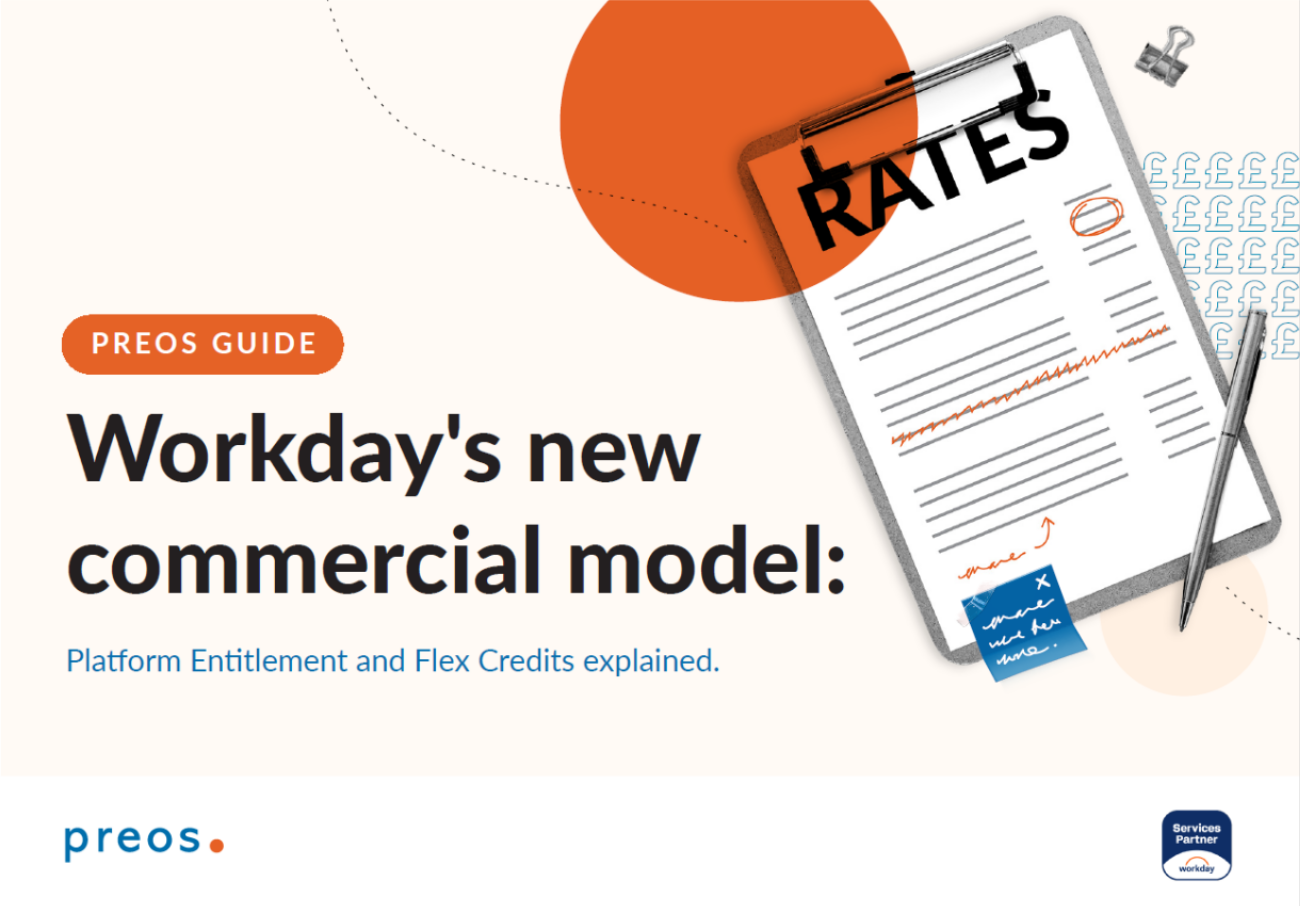
A guide to Workday’s new commercial model
An in-depth, plain-language explainer of Workday’s new commercial model: the contractual framework, Platform Entitlement and Flex Credits, how they connect, what triggers the change for your organisation, what to weigh now and what is still undefined.
What changes for you.
The practical consequence is that your commercial relationship with Workday becomes something you monitor and manage, rather than something that runs in the background between renewals.
Under the old model, once the contract was signed, there was little to watch. Your use of the platform did not have any cost implications, so nobody needed to track it. Under the new model, usage has consequences. That applies both to how you use the platform itself and to how you use AI agents if activated.
The UMSA is the trigger.
The vehicle for the change is the Universal Main Subscription Agreement, or UMSA. This is Workday’s new contractual framework and the gateway to its agentic AI capabilities.
For most customers, the move to the UMSA happens at their next renewal. It is possible to move earlier if you want to, and there are reasons some organisations choose to.
The new commercial model has two components: Platform Entitlement, and Flex Credits, the currency through which you access Workday’s AI agents. They are two separate parts of the same framework, and they are connected in ways that are worth understanding properly.
Why preparation matters more than it used to.
The organisations that will get the most from this model are those that enter the renewal conversation with an understanding of their own position, rather than working it out during the conversation itself.
That is a different discipline from the one most Workday customers have needed until now. It means knowing what your current usage looks like. It means understanding which AI agents are genuinely relevant to your organisation and which are not, before you commit to a volume of credits. It means having a view of your likely consumption, grounded in your own environment.
There is also a broader point here. Workday AI is only as effective as the tenant, data and processes underneath it. Organisations with incomplete configuration or poor data quality will find that AI amplifies those problems rather than solving them.
The commercial question and the readiness question are more closely linked than they first appear.
Where to start.
If Workday’s commercial model is something you need to get to grips with, the first step is understanding how it works and what it means for your organisation.
We have written a guide that sets out the whole model in plain terms. It covers what Platform Entitlement and Flex Credits are and how they connect, what your complimentary allocation is and how it is calculated, how credits are consumed and what drives cost, what counts towards your entitlement and what happens if you exceed it, which parts of the model are not yet settled, and what we would suggest doing now.
If you would rather talk it through, Preos works with Workday customers on exactly this. Our Commercial Advisory work establishes where you stand today, models your likely consumption and cost under realistic scenarios, and prepares you for the conversation with Workday.